Sunday, 31 May 2009

Awesome bit of folk singing in the Southbank centre this afternoon courtesy of the Cecil Sharp House Community Choir. With a nice mix of traditional English songs and those from Eastern Europe and a generous helping of sea shanty-esque fun who could possibly object? Also the Southbank centre seems to do a lot more free lunchtime concerts than I realised - I think I will investigate further...

Oh yes and this is Cecil Sharp:

Saturday, 30 May 2009

Crunchie Boost Update


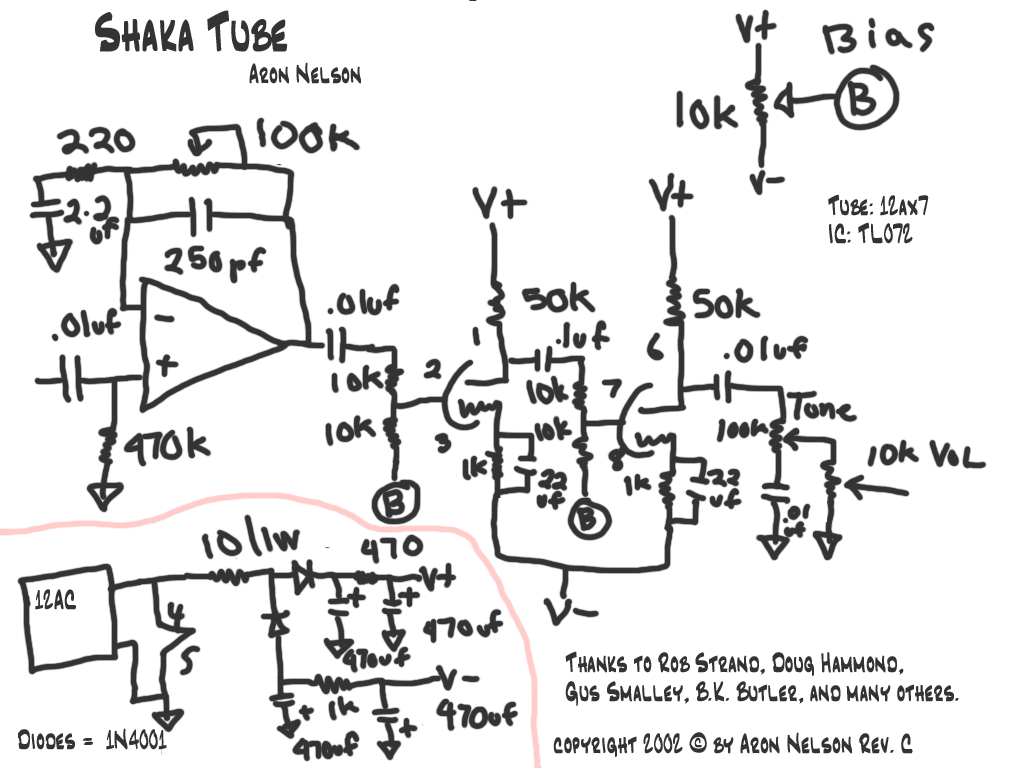
My new pedal is coming along quite well. I decided to assemble it on stripboard rather than try to make a PCB due to my inherent laziness but I doubt it will make a huge difference to the sound as we're working with pretty low voltages. So far I have put together the preamp section (blue on the schematic) and tested the rest of the circuit above in the lab. It is essentially the Shaka tube by Aron Nelson but using 9V and with a gain control in the tube section that I am calling the "crunch". Looking at the output on the oscilloscope there was some nice, if subtle, clipping of a sine wave input. Of course it's difficult to know what this will actually sound like but we shall see - if it is not overdrivey enough I'll have to think about altering the point at which the second half of the tube stage is biased and maybe use this as the "crunch control". Also, obviously there will be an output stage with simple tone and volume controls and the supply circuit. The latter is rather interesting as I am hoping to get +9V and -9V from the standard Boss DC power supply using a MAX1044 switched-capacitor voltage converter. I think the current is within the operating limits of the converter as long as I don't try to use it to power the tube heating elements! In the lab the tube section and the preamp section were drawing about 0.2mA each but I'd better check that more carefully. It could all go horribly wrong from this point...

(PS I'll put some more pictures/schematics/oscilloscope traces up in following weeks.)

Sunday, 24 May 2009

Recording studio pics

As promised - some pretty pictures showing the simplicity that is my studio (although it usually looks more of a mess when I'm actually doing something). It's amazing how little you need to get a good recording these days, no more floor to ceiling rack of effects just a fast computer.


Thursday, 21 May 2009

Thor

The new synthesiser in Reason (sorry I'm a bit obsessed with it at the moment) is ridiculous. It's going to take me the next month just to get through the million online tutorials before I even begin to understand what is essentially seems to be a combination of every synth from the Moog to the DX7.

But I will persist since Robert Moog said himself that "computers are the most important thing to happen to musicians since the invention of catgut which was a very long time ago." And computers don't involve extracting sheep intestines which is always an advantage. Hmm... remind me not to get any gut strings for my 'cello, as much as I like a bit of crazy baroque that is pushing the need for authenticity too far.

Tuesday, 19 May 2009

Delay... not the good kind

While wandering home and thinking about what to add to my blog I noticed a board in the tube station covered with "minor delays" signs and so I will talk about delay, well actually latency but meh.

When doing digital recording it is always important to consider latency or the time delay between a signal entering your audio interface and it leaving through your monitors. The more complex your studio and the more software effects you apply the larger this effect becomes. And it can be very annoying! You can be happily rocking along to a click track only to play it back and find the timing is out by a few tens of milliseconds. Having said that most modern audio interfaces are excellent at compensating for this and are often advertised as "zero latency". The particular problem I have is that I have two audio interfaces (see My Studio below) - an M-AUDIO Firewire 410 and a Line 6 TonePort UX2. I like to have my monitors connected to the 410 but record most of my guitar stuff through the UX2. The two methods I use are as follows (neither ideal but nothing is in a home studio):

1. Have input and output set to different audio interfaces in my sequencing software. Goodness: easy to record and route signals. Badness: Latency, lots of. Most software generally seems to prefer dealing with as few hardware devices as possible hence the problem. The latency is correctable (well in Ableton Live it is) but also variable.

2. Use my 410 for the audio input and output and feed the digital output (s/pdif) on the UX2 into the 410. Goodness: Minimal latency. Badness: Not as flexible as the first idea and also can be temperamental as you have to sync the clocks on the two interfaces. Basically my 410 has to use the clock source in the UX2 that is transmitted with the digital audio by the s/pdif cable. If this clock signal loses sync (as seems to happen whenever I turn my cooker on!) all my music suddenly becomes horribly distorted. 

Actually the other option is to keep swapping between interfaces but this requires a lot of cable changing each time I want to play something back and I can't then always monitor using the 410. Anyways I am starting to prefer the second option especially as the reliability of the s/pdif connection seems to have improved now I have the most up-to-date software and a faster computer, or maybe I'm just imagining stuff. It does however bring me to the topic of clock sources in digital recording but I want food so I'll leave it to another day.

Thursday, 30 April 2009

I have returned

So, back from California and about time I updated my blog. Here's a nice San Francisco photo to begin with...


This was taken just north of the Golden Gate bridge on the way to Sausalito and if you zoom in manages to show Alcatraz, a bit of Oakland, the Bay bridge, San Francisco itself, Fort Point and the Golden Gate bridge all, rather awesomely, at once.

Anyway back to the music and I think I am going to upgrade from Reason 2.5 to 4. I've been using Reason for a long time and it is the coolest music software ever - who cares that the animated cables when you shake the window are completely pointless? The annoying thing is that I have to upgrade for ReWire to work properly on my Intel based mac (as far as I can tell Reason 3.0.5 and newer is universal binary). If you don't know, ReWire is a software re-routing tool that means you can have all your Reason instruments playing, in sync, inside whatever audio sequencer you are using. It makes recording vocals, guitars etc. with for example Reason drums or a synth ten times easier since you do not have to mix down and import all the Reason tracks to listen to the whole song. The way it normally works is straightforward - open your sequencer then open Reason. Reason will go into slave mode and pressing play in either application will play both together. Sequencer tracks can then be set up to take the signal from any of the Reason instruments or outputs. Basically very useful and just about worth the 99EUR upgrade. If only I'd got it when the exchange rate was better :(

Tuesday, 7 April 2009


Mmmm tubey goodness (courtesy of shanegorski)

Intro to the Crunchie Boost

I'm going to try to keep a log of the progress of my guitar effects pedal that I am slowly building (very slowly). In theory as a physicist with access to a fully equipped electronics lab it should be easy, however, finding time when I don't have actual work to do is challenging.

Anyway it is going to be a tube overdrive/boost and hence will be named the Crunchie Boost after two rather well known confectionery items. The circuit is based on the Shaka Tube but initially I wanted to run it off the standard Boss 9Vdc power supply used by many pedals. In a brain-dead moment I got it into my head that this would provide me with +9V and -9V which it won't! Hence I'm now pondering the next move - maybe using a simple voltage doubling circuit for the op-amp input stage but this can't be done for the high current tube output section. I'm not sure 9V is enough of a plate voltage for the tube so it's off to the lab for some experimenting...